Skip to content

Cart

Your cart is empty

Continue shopping

🎁 3+1 FREE

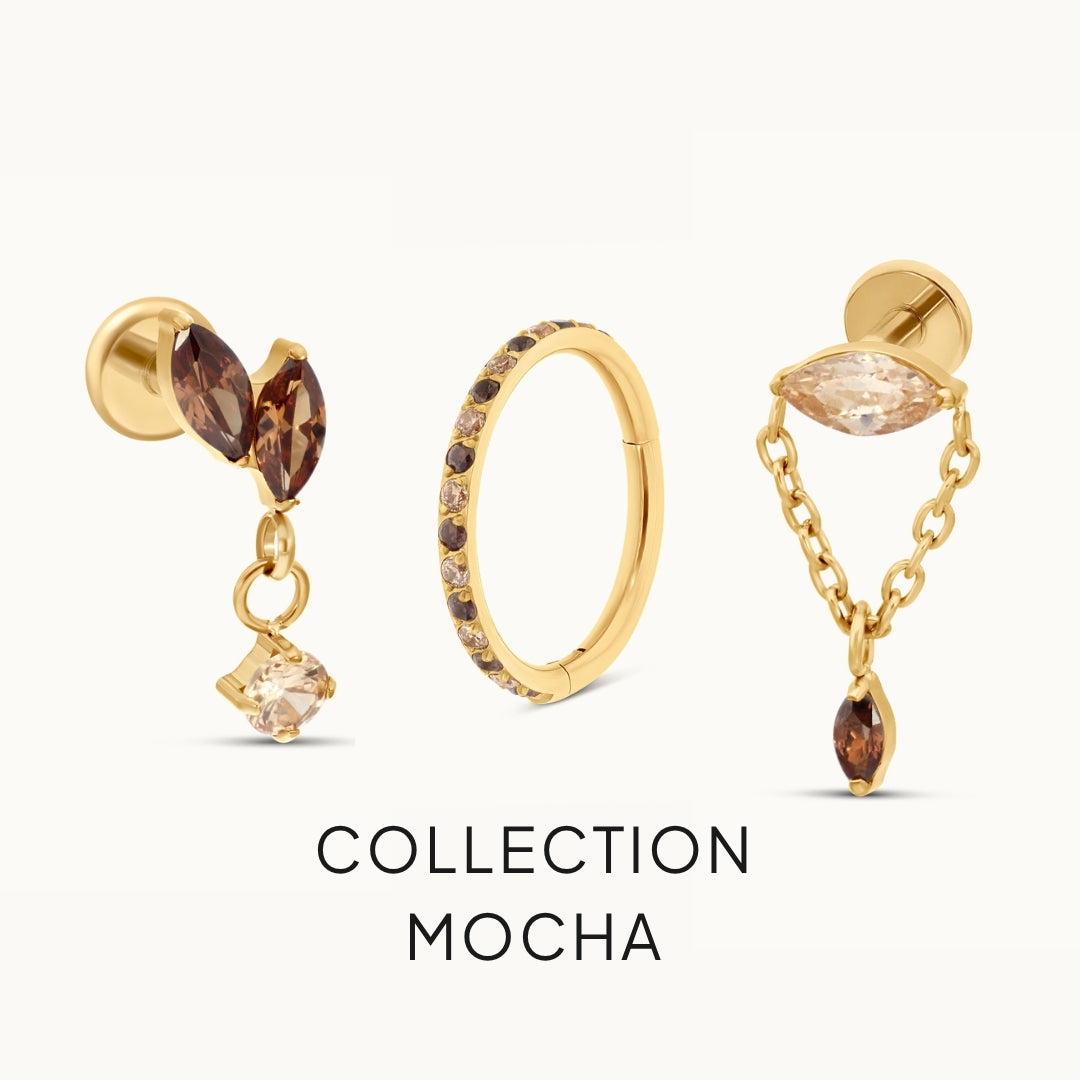
Buy 3 pieces and the 4th is free: the discount applies automatically to the cheapest piece, from 4 pieces in your cart. Also valid on the MOCHA collection.

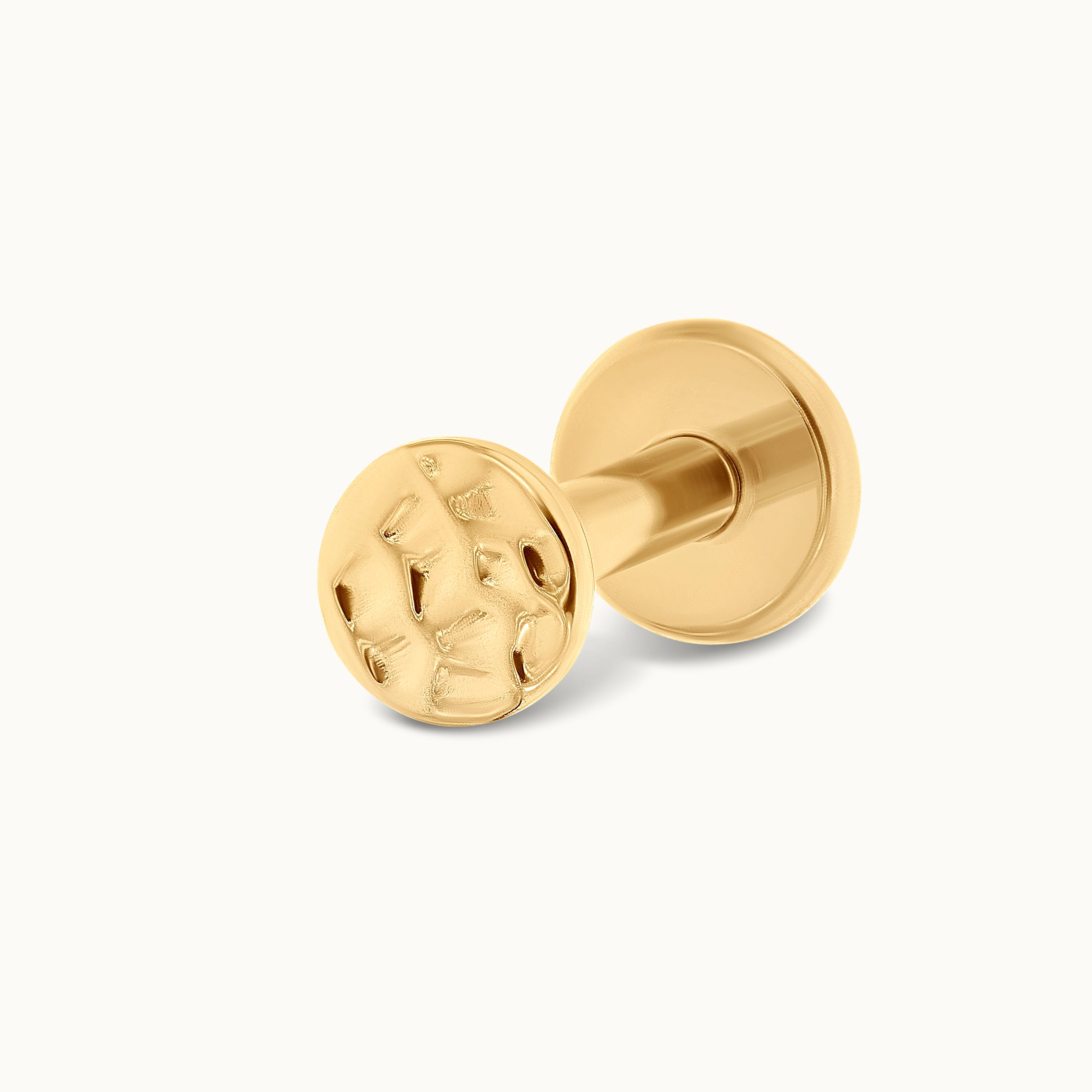
HAMMERED DISC

Sale price€12,00
Color: Gold
Size: 1.2 x 3mm
Size Guide - Piercing Jewelry

Find the right size for your piercing, placement by placement.

The sizes shown are for your final jewelry, once the piercing has healed. The bar fitted at the time of piercing is deliberately longer: do not use it as your reference when ordering.

Illustration - How to measure your jewelry - Obsidian Piercing

Lengththe post only, from base to tip, without the ends
Diameterthe inside of the hoop, measured at its widest
Thickness1.2 mm standard · 1.6 mm nipple, navel, tongue · 0.8 to 1 mm nose
Which thickness (mm) should you choose?
The standard1.2 mm
We pierce at 1.2 mm almost every time, like most piercers. If a professional pierced you, your jewelry is very likely this thickness.
Pierced at a jewelry counter or with a gun?often 0.8 or 1 mm
You can wear a 1 mm labret, which fits that hole, or move up to the standard 1.2 mm with an insertion taper (a small cone that eases the jewelry through). When in doubt, measure the piece you are wearing.
Want a thinner hoop?1 mm or 0.8 mm
Once the piercing has healed (the point at which a hoop becomes possible), you can go for a thinner hoop, in 1 mm or 0.8 mm. For labrets, 1.2 mm remains the reference: going thinner is only useful to fit a narrow hole (see above).
Ear
Lobe
Bar (labret)1 / 1.2 / 1.6 mm · 6 to 8 mm
Depending on how thick your lobe is. The closer the fit, the more comfortable the bar.
Hoop1.2 or 1.6 mm · ⌀ 8, 10 or 12 mm
8 = close to the lobe · 12 = roomier
Hoop: can be fitted straight away, from the day you are pierced.
Helix
Bar (labret)1.2 mm · 6 or 7 mm
Fully healed? The shorter one will be the most comfortable.
Hoop1.2 mm · ⌀ 8 or 10 mm
8 = close to the cartilage · 10 = more open
Shorter bar: ~2 months (check-up visit) · hoop: 6 months recommended.
Conch
Bar (labret)1.2 or 1.6 mm · 7 or 8 mm
Hoop1.2 or 1.6 mm · ⌀ 10 or 12 mm
The diameter should clear the outer ear without pressing on it.
Shorter bar: ~2 months (check-up visit) · hoop: 6 months recommended.
Tragus
Bar (labret)1.2 mm · 6 or 7 mm
6 mm in most cases.
Hoop1 or 1.2 mm · ⌀ 6 mm
Shorter bar: ~2 months (check-up visit) · hoop: 6 months recommended.
Daith
Hoop1.2 mm · ⌀ 8 or 10 mm
Hoop: possible from the day you are pierced. A horseshoe is a better choice for the first few months, while it heals.
Rook
Curved barbell1.2 mm · 7 or 8 mm
Hoop1 or 1.2 mm · ⌀ 6 mm
Hoop: 6 months recommended.
Anti-helix
Bar (labret)1.2 mm · 5 or 6 mm
6 mm in the vast majority of cases.
Hoop1 or 1.2 mm · ⌀ 6 mm
Shorter bar: ~2 months (check-up visit) · hoop: 6 months recommended.
Flat
Bar (labret)1.2 mm · 5 or 6 mm
6 mm in the vast majority of cases. The flat is worn with a bar only, never a hoop.
Shorter bar: ~2 months (check-up visit).
Industrial
Straight barbell1.6 mm · 30 to 40 mm
The length varies a great deal with your anatomy: the safest route is to measure the piece you are wearing, or to ask your piercer.
Nose & face
Nose (nostril)
Bar (labret)1 or 1.2 mm · 7 mm
7 mm recommended · 6 mm once fully healed · 8 mm uncommon
Hoop0.8 or 1 mm · ⌀ 7 or 8 mm
Hoop: 6 months recommended.
Septum
Hoop1.2 mm · ⌀ 8, 9 or 10 mm
8 = discreet · 10 = more visible
Hoop: can be fitted straight away, from the day you are pierced.
Labret / Medusa
Bar (labret)1.2 mm · 7 or 8 mm
Shorter bar: ~2 months (check-up visit).
Smiley
Hoop1.2 mm · ⌀ 8 or 10 mm
Body
Navel
Curved barbell1.6 mm · 10 or 12 mm
Nipple
Straight barbell1.6 mm · 12, 14 or 16 mm
18 mm exists but stays rare. It varies with your anatomy: measure the piece you are wearing, or ask your piercer.
Tongue
Straight barbell1.6 mm · 14 or 16 mm
The safest reference: measure a piece you already wear, or ask your piercer for its size. For personal advice, our piercers welcome you in our studios in France.
Our jewelry comes sealed in a hygiene pouch: check the dimensions through the packaging before opening it.

How to measure accurately

The most reliable method is still to measure a piece you already wear and that suits you. If you cannot measure it (a piece you are unable to remove, for example), ask your piercer for the exact size of the one they fitted.

  • Bar (labret, barbell): measure the post only, from base to tip, without the ends screwed on at each side.
  • Hoop: measure the inner diameter, from one inside edge to the other. Do not measure the outside of the circle, that is the most common mistake.
  • Curved barbell: measure in a straight line from one end to the other, not along the curve.

Jewelry thickness

The piercing standard is 1.2 mm, roughly the thickness of a paper clip. It is the gauge of most ear and face piercings. Areas under more strain, such as the nipple, the navel or the tongue, use 1.6 mm, which suits their healing better. 1 mm gives a finer look on the nose, the tragus, the rook or the septum, and 0.8 mm is reserved for fully healed piercings.

The most common mistakes

Forgetting the downsize. The bar fitted at the piercing appointment is longer than the final jewelry. Once the swelling has gone down, it has to be replaced with a shorter bar. At Obsidian, we take care of this at the systematic check-up, 2 months after the piercing in our studios in France. A bar that is too long catches, moves around and irritates the channel.

Underestimating how much swelling varies. The bar fitted at the piercing appointment is deliberately a little longer, to allow for the swelling of the early days, without being too long: an over-long bar catches and ends up irritating the piercing as well. Everyone reacts differently. More pronounced swelling, because you slept on that ear for example, can make the bar feel too short for a while. That is normal, it has nothing to do with the quality of the piercing, and your piercer will adjust the length if the discomfort settles in.

Switching to a hoop too soon. We recommend waiting 6 months before moving to a hoop, to limit the risk to healing. Cartilage that has not finished healing takes the change badly. Ask your piercer what they think of the state of your piercing. The lobe and the septum, for their part, take a hoop earlier.

Relying on the standards alone. The thickness of your cartilage, the curve of your ear, the depth of your conch: every anatomy is different. These recommendations are professional reference points, not universal certainties.

Healing: how long it takes, area by area

Area Estimated time
Lobe 2 to 4 months
Helix, tragus, conch, anti-helix 6 to 12 months
Rook, daith 6 to 12 months
Nose (nostril) 3 to 6 months
Septum 3 to 6 months
Labret, medusa 3 to 4 months
Navel, nipple 6 to 12 months

A piercing can look healed on the surface long before it is healed deeper down. Stick to these timings before considering a change of jewelry.

Materials: as decisive as size

On a pierced area, the material stays in permanent contact with your skin: the wrong piece can irritate it, slow the healing down or trigger a reaction.

ASTM F-136 titanium is our reference material, and the one we recommend for a first piercing. Biocompatible and nickel-free, it is the grade of titanium used for medical devices: the skin tolerates it well, even on a fresh piercing.

Solid 14k and 18k gold is biocompatible too and remains a lovely option on a fully healed piercing. Titanium is still the safest choice during the early stages, however.

So-called “surgical” steel, like most common materials, is not biocompatible: we do not recommend it for piercings.

Every piece we offer, we fit it and pierce with it ourselves, every day, in our studios in France. That is the most honest guarantee we can give you.

Size

In stock
30 days to change your mind
Safe & lasting materials
2-year warranty

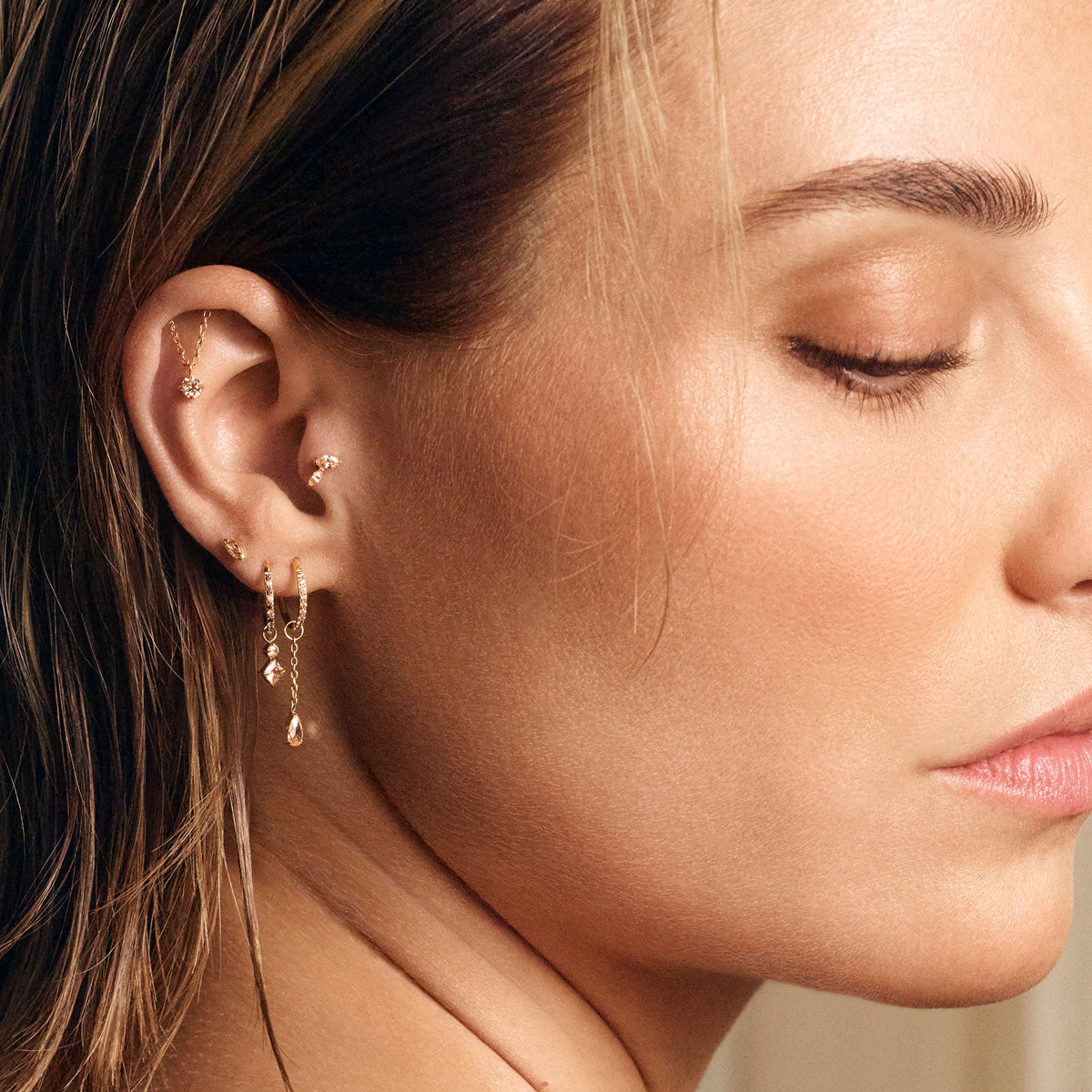
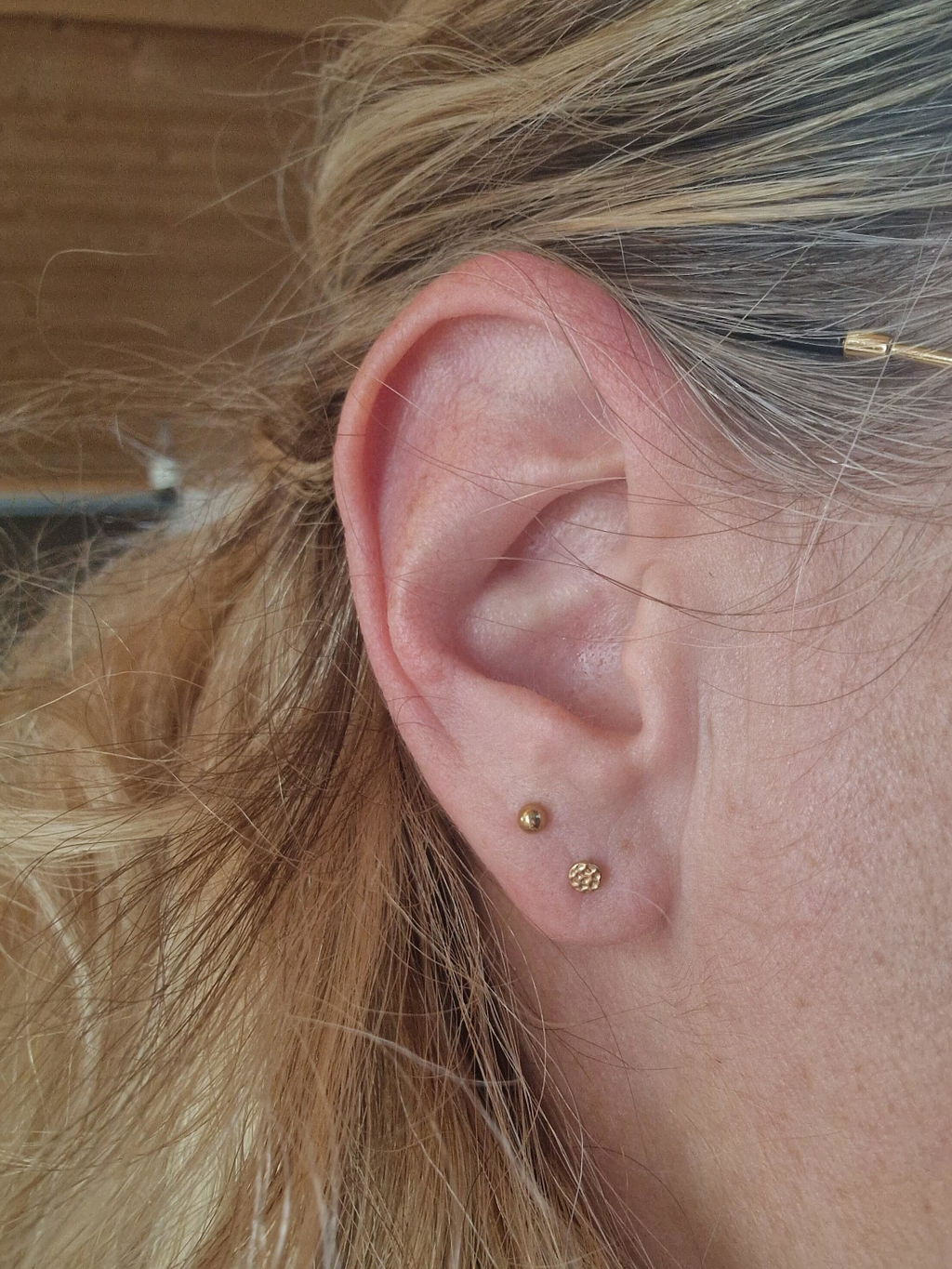
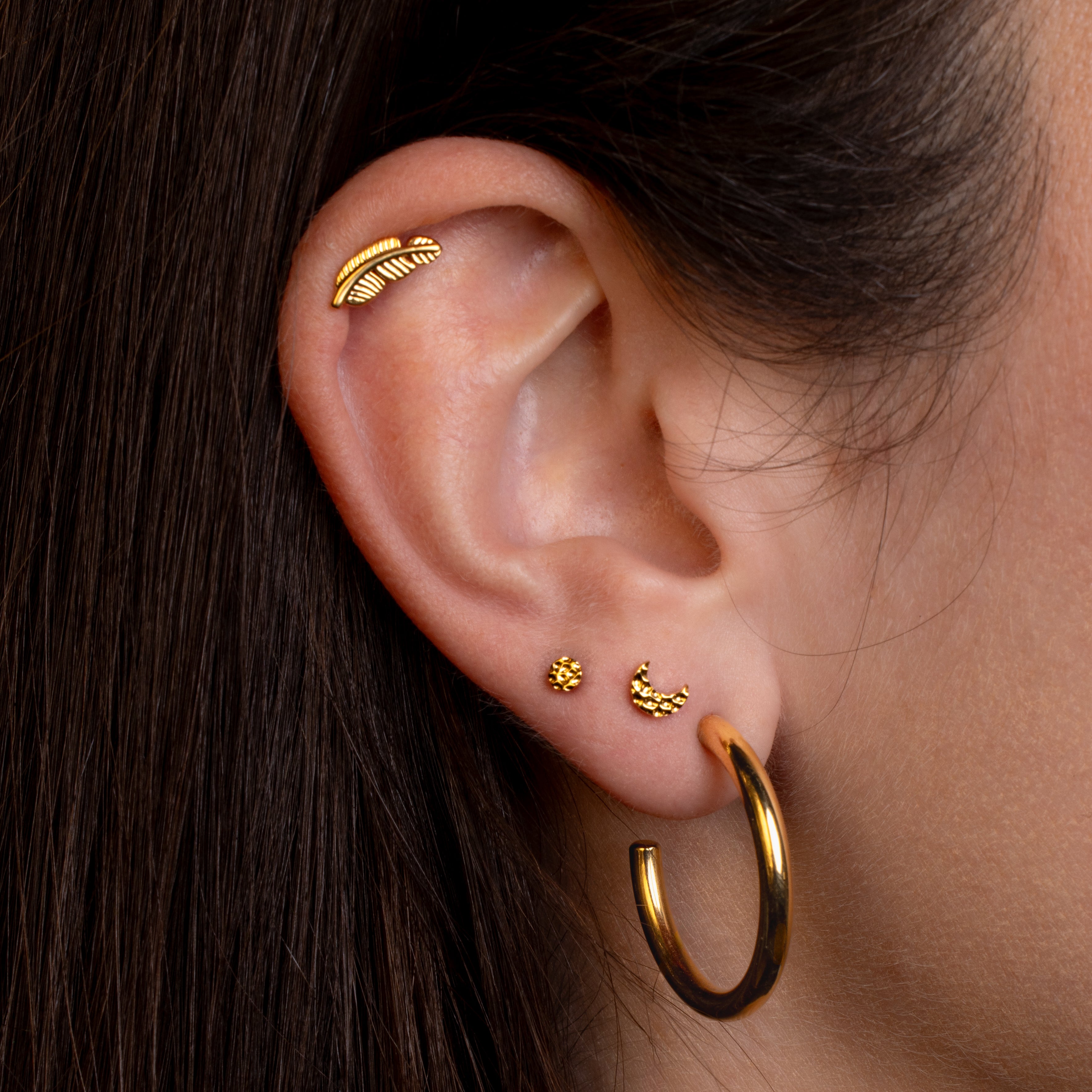
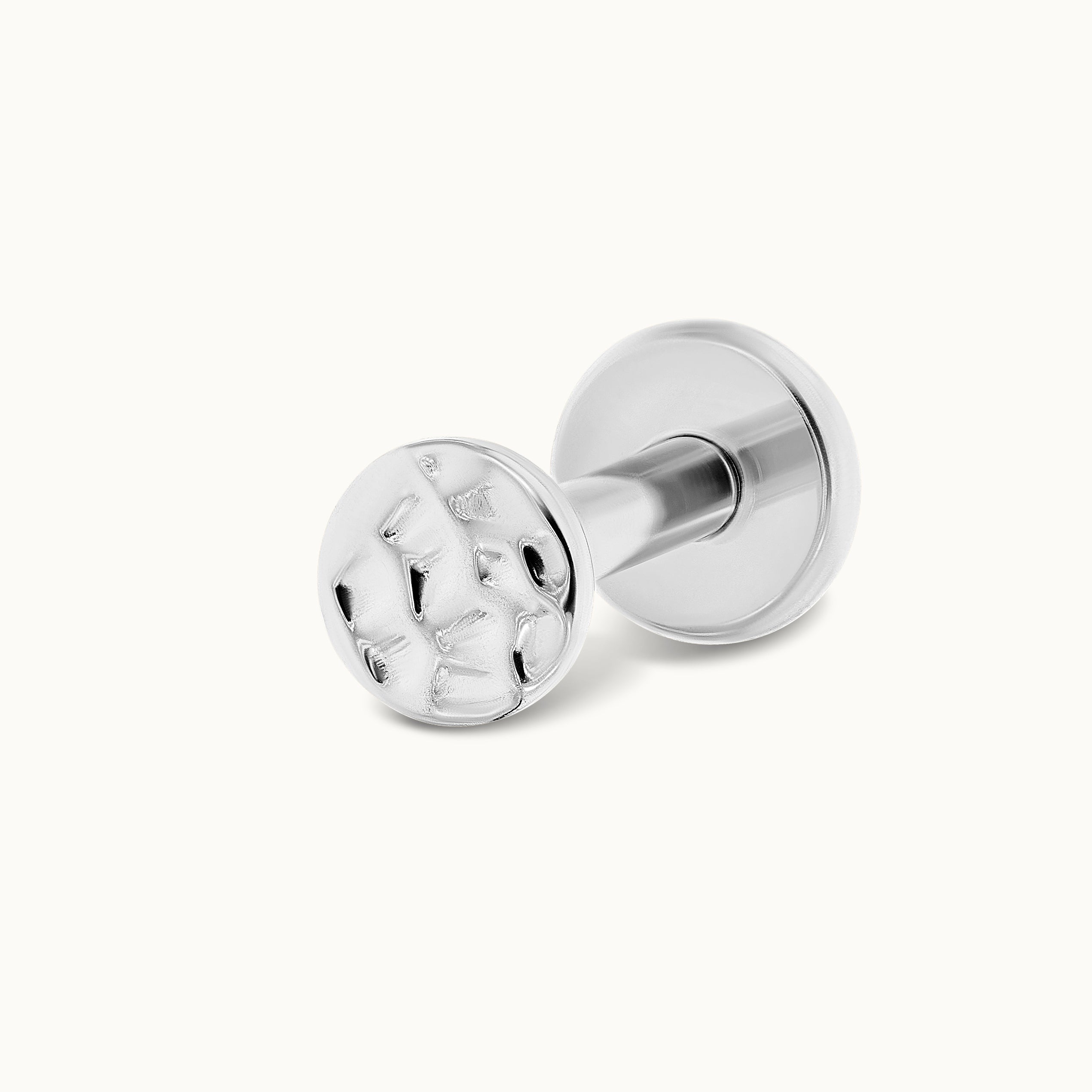
Catch the light with a texture all its own. Its hammered surface brings a raw, elegant touch to your ear stack, ideal for a tragus or a helix worn discreetly. This minimal titanium piece stays firmly in place thanks to its internal threading.

 

Specifications

There are several reasons to choose the excellence of our titanium for your healed or recent piercings:

  • Material: ASTM F-136 titanium.
  • Safety: Hypoallergenic, biocompatible, guaranteed nickel-free.
  • Resistance: Water-resistant (shower and swimming) and built for everyday life.
  • System & finish: Secure internal threading. Available in titanium (silver) or Gold PVD (gold).

📦 Included : Your jewelry comes mounted on a standard 1.2 x 7 mm bar. Customize your size by ordering it on the Labret page.

Recommended placements
  • Lobe
  • Helix
  • Tragus
  • Anti-helix
  • Conch
  • Medusa
  • Nostril (nose)

Every anatomy is unique. Our size guide helps you choose the right barbell length. For personalized advice, our online customer care team or our piercers in our studios in France are happy to help.

HAMMERED DISC
HAMMERED DISCGold / 1.2 x 3mm Sale price€12,00

Chosen by our piercers, fitted every day

Our co-founder has been piercing for more than fifteen years. Every piece we sell is one we wear and fit every day in our stores in France. We want to give every online customer the same attention, the same standard. You get the rigor of a team that puts its craft and its reputation behind every piece.

  • More than 15 years of expertise
  • Fitted in store every day
  • Piercers who listen

Your skin doesn't compromise

Piercing jewelry is worn in the shower, during sport, in your sleep. Materials that sit against your skin 24 hours a day aren't a marketing question. They're a health one. Certified biocompatible ASTM F-136 titanium, solid 14k and 18k gold: every material is chosen for how well your body tolerates it.

  • Certified biocompatible titanium
  • Lasting quality, constant comfort
  • Suited to sensitive skin

frequently asked questions

Shower, pool, sea: can I keep my jewelry in?

Our jewelry is designed to be worn permanently, including in the shower, in the pool or in the sea. ASTM F-136 titanium and solid gold are unaffected by water, chlorine or salt. You don't have to think about it.
Ideally, do rinse your jewelry with clean water after a swim in the sea or in a chlorinated pool.

My piercing is new — can I wear this piece?

All our jewelry is made from ASTM F-136 titanium or solid gold, the only two materials recommended during and after healing. For a piercing that's still fresh, we recommend checking with your piercer before any change. Our customer care team and our piercers in our stores in France can guide you too.

Single or pair: what does the price include?

Each piece is sold individually, leaving you free to build your own combinations. When a pair is offered, it's stated on the product page.

Is this piece suitable for sensitive skin?

Yes. The ASTM F-136 titanium we use is nickel-free and recognized for its biocompatibility, which makes it well suited to sensitive skin. That's exactly why we chose to work only with materials of this standard.

Will my jewelry keep its shine over time?

Our materials are chosen for how they hold up over time. Titanium doesn't tarnish, and solid gold keeps its shine with no surface treatment. Unlike plated or gold-filled jewelry, there's no layer to wear away.

How do I choose the right size for my piercing jewelry?

Every piercing has its own dimensions, which vary with the area and your anatomy. Take a look at our size guide on the site, or contact us directly: our piercers and our customer care team can point you in the right direction.