

Industrial Piercing: Your Complete FAQ Before You Get Started
Thinking about getting an industrial piercing? This striking piece keeps winning over more fans, but it also raises plenty of questions: does it hurt? How long does it take to heal? Which jewelry should you choose to avoid complications? In this article, we answer all your questions and walk you through every step to make it a success.
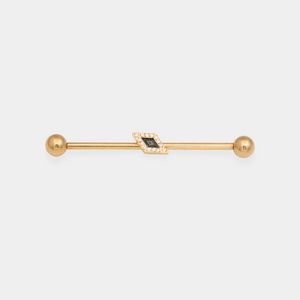
What is an industrial piercing?
A quick definition
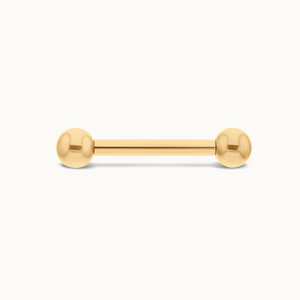
The industrial piercing is a double perforation of the ear cartilage, connected by a rigid straight bar.
It usually runs diagonally across the upper ear (helix). This type of piercing stands out for its linear look and the direct connection between the two piercing points.
Why is this piercing so popular?
It gives a bold look. The industrial piercing has become a trend-forward choice for fans of original piercings, letting you express your personality boldly while staying within a minimalist, structured aesthetic.
Does an industrial piercing hurt?
What most people feel
Since cartilage is denser than the lobe, the pain is often described as a sharp, brief pinch, followed by lingering tenderness for a few days.
Some people report a slight throbbing or pressure sensation in the hours following the piercing.
Factors that influence how much it hurts
- Individual pain tolerance
- The piercer's experience and speed
- How tired or stressed the client is
- The equipment used and the type of jewelry
Industrial piercing: how long does it take to heal?
The stages of healing
Healing for an industrial piercing can take 6 to 9 months or more. It's normal to see some redness, light crusting or mild swelling in the first few weeks.
It's important to respect the healing time your own body needs, since some people heal more slowly, especially if the piercing is mishandled or exposed to repeated pressure.
What to avoid during healing
- Sleeping on the piercing
- Changing the jewelry too early (wait at least 6 months)
- Touching it with unwashed hands
- Using unsuitable products like alcohol or peroxide
- Picking off the crusting on your industrial piercing
Which jewelry should you choose for an industrial piercing?
The straight barbell: the classic, recommended choice
This is the go-to jewelry for this type of piercing. It needs to be long enough to allow for initial swelling.
Straight barbells come in several sizes and designs, but the starter piece should always be smooth and free of excessive decoration, so it doesn't irritate the area.
Why choose ASTM F-136 titanium jewelry?
- Hypoallergenic: ideal for sensitive skin
- Lightweight and comfortable for everyday wear
- Nickel-free: lower risk of skin reactions
- Biocompatible: a material used in the medical field
- Recommended by professionals for the first fitting
ASTM F-136 titanium is considered the safest standard for piercings, thanks to its stability and durability.
Can you sleep on your industrial piercing?
It's strongly discouraged to sleep on the pierced side. This can shift the jewelry, irritate the cartilage, or prolong healing.
We recommend sleeping on the opposite side, or investing in a piercing pillow with a center cutout, designed to take the pressure off your ear. This kind of accessory can really help protect your piercing while you sleep, especially in the first few months when the area is still sensitive.
What are the risks with an industrial piercing?
Infections, swelling, keloids: how to avoid them
The risk is lower when the piercing is done under good conditions, with quality jewelry (ASTM F-136 titanium), and when aftercare is followed carefully. If in doubt (persistent pain, discharge, intense redness), it's important to see a professional quickly.
Materials to avoid for your industrial piercing
Avoid costume steel or uncertified materials. These can contain nickel or cause irritation. ASTM F-136 titanium is the safest material for optimal healing.
Is an industrial piercing suited to everyone?
Checking your anatomy before the piercing
Some ears don't allow for proper alignment between the two required holes. Only a professional piercer can confirm whether it's feasible, by assessing the shape and thickness of your cartilage.
What alternatives exist if your ear isn't suited to it?
- Double helix: two piercings with independent jewelry
- Two separate piercings
- A transverse or custom piercing suited to your anatomy
Where should you get your industrial piercing done?
It's essential to get pierced in a professional studio, with sterilized equipment and quality jewelry.
Jewelry stores using a piercing gun should be avoided, since this method isn't suited to cartilage and can cause trauma.
A good piercer takes the time to explain the procedure, the aftercare to follow, and makes sure you fully understand what's involved.
What's the average price of an industrial piercing?
Prices typically range from €40 to €70 depending on the studio, its location and the piercer's experience. ASTM F-136 titanium jewelry may cost a little more, but it means better tolerance and easier healing.
This price usually includes the piercing itself, aftercare advice, and quality jewelry.
Our tips for a successful industrial piercing
Choosing the right time to get it done
Avoid periods of intense activity, holidays, or hot weather. A calm, stable environment supports smoother healing.
Never skip aftercare
Gently clean it twice a day with a sterile saline solution. Use sterile gauze pads to clean your piercing. Never rotate or handle the jewelry. Avoid makeup, hair products or knocks.
Always choose titanium jewelry from the first fitting
Good material lowers the risk of infection and irritation, and supports faster healing. ASTM F-136 titanium is the recommended option for every cartilage piercing.
Choosing quality jewelry gives you every chance of a successful experience and a good-looking result that lasts.
Discover our collection of industrial piercing jewelry in titanium in our online store, and choose safety and style.