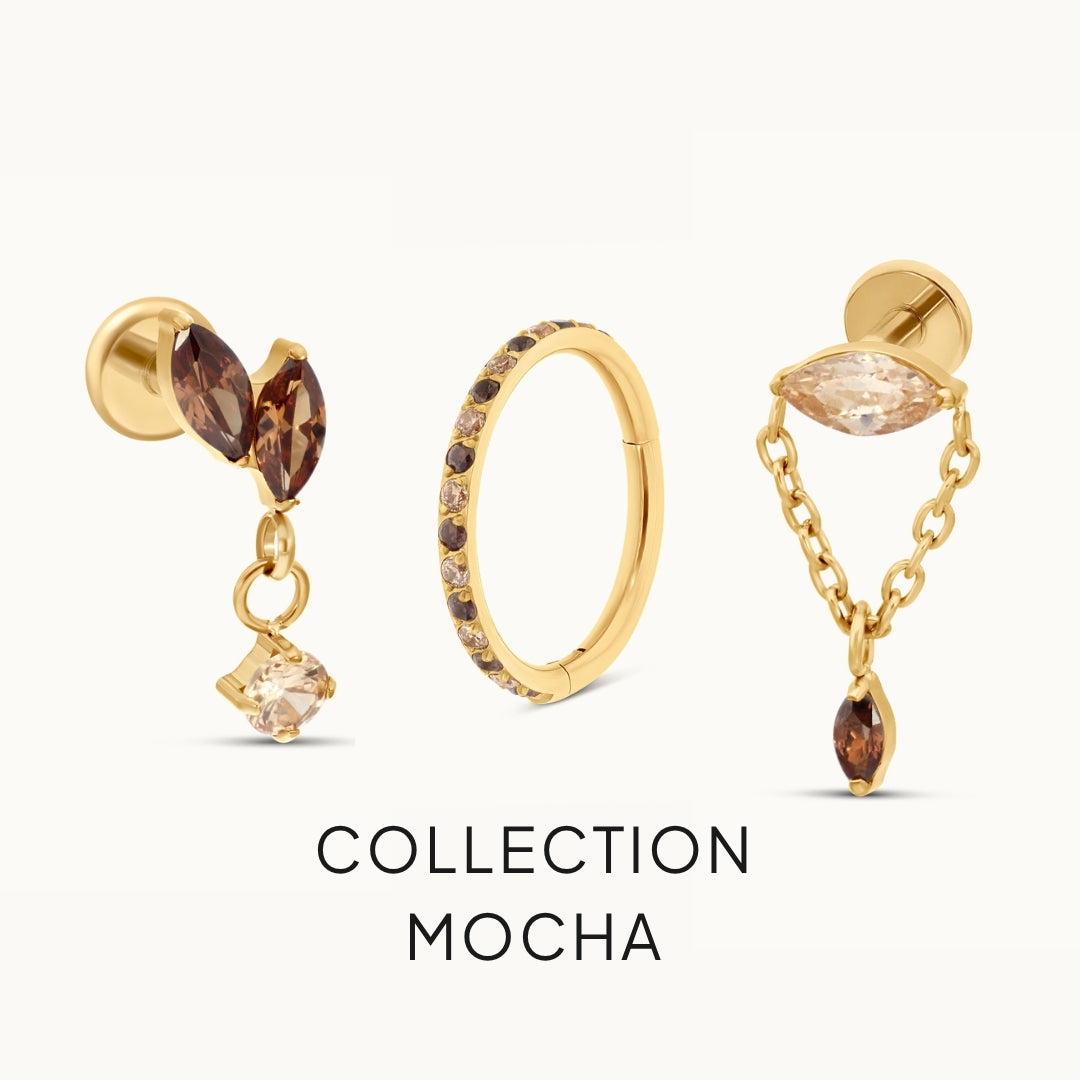



Helix Piercing: Which Materials Should You Absolutely Avoid?
Choosing the right material for a helix piercing is essential to avoid infection, allergies and rejection. Some metals, though common, can cause serious healing problems. In this article, we go through the materials to absolutely avoid, the risks they carry, and why ASTM F-136 titanium remains the safest, most recommended choice.
What is a helix piercing?
Definition of a helix piercing
The helix piercing goes through the upper cartilage of the ear. It's especially popular for its discreet, elegant look, and comes in several forms: standard helix, double or triple helix, forward helix, and reverse helix.
Why is the material choice so crucial?
The material you choose for a helix piercing has a direct impact on healing. A poor choice can lead to infection, irritation, or even jewelry rejection. For a first fitting, it's essential to choose a biocompatible material to limit these risks.
Materials to avoid for a helix piercing
Surgical steel: a metal that contains nickel
Surgical steel is used in costume jewelry, but it's also one of the more allergenic metals. Reactions can include redness, itching, inflammation and, in some cases, severe infection. Surgical steel contains nickel, which can cause problems, especially during healing.
Silver: an oxidation risk
Silver is a material often used in jewelry, but it comes with several drawbacks when used for a helix piercing, especially during the healing phase. One of silver's main issues is that it oxidizes quickly on contact with air and moisture. This reaction darkens the jewelry's surface, which can irritate the cartilage.
For all these reasons, silver is strongly discouraged for a first fitting. Once healing is fully complete, gold-plated or rhodium-plated silver jewelry can be an option, but it's still best to favor hypoallergenic materials like ASTM F-136 titanium.
Piercing jewelry containing brass and copper
Both of these metals are quite porous, which encourages bacteria to build up. Brass and copper can cause irritation, itching, and slower healing, raising the risk of infection.
Why is ASTM F-136 titanium the best choice?
The properties of biocompatible titanium
ASTM F-136 titanium is a medical-grade material, known for its hypoallergenic, biocompatible properties. Unlike other metals, it doesn't trigger rejection by the body and resists oxidation perfectly.
Comparison with other common materials
- Titanium vs. surgical steel: titanium is lighter and even better tolerated by the body. ASTM F-136 titanium contains no nickel, while surgical steel often does, which can be a problem for sensitive people.
- Titanium vs. gold: 14k or 18k gold also works well, but it's more expensive. Titanium remains the best value for money.
ASTM F-136 titanium: the best choice for a helix piercing
This material is used in medical implants, which is exactly what makes it an ideal choice for first-fitting piercings. Professional piercers recommend it for:
- Its biocompatibility: it's perfectly tolerated by the human body, avoiding allergic reactions.
- Its resistance to oxidation: titanium doesn't rust or degrade on contact with water or air.
- Its lightness: unlike other metals, titanium is very light, making it more comfortable day to day.
- Its lack of nickel: it's completely nickel-free, reducing the risk of allergies.
- Its durability: titanium jewelry keeps looking new for years.
These qualities make ASTM F-136 titanium the reference material for fast, trouble-free healing.
The risks of unsuitable materials for a helix piercing
Allergies and inflammation
Using unsuitable metals can trigger allergic reactions: itching, redness, swelling. This irritation slows healing and raises the risk of infection.
Infections and poor healing
Jewelry made from porous or poorly tolerated materials makes infection more likely. Poor healing can lead to keloids or painful abscesses.
Jewelry rejection: a real risk
An unsuitable material can lead to complete jewelry rejection. The cartilage pushes the jewelry out, causing pain and chronic inflammation.
Bonus – FAQ
How do you care for titanium jewelry after a helix piercing?
To care for titanium jewelry after a helix piercing, clean it regularly with a sterile saline solution. You can clean it twice a day. Since titanium is non-porous and resistant to oxidation, regular cleaning is enough to remove buildup and prevent irritation. Avoid harsh products like alcohol or hydrogen peroxide, which can dry out the skin.
Can you sleep on a titanium helix piercing?
It's not recommended to sleep directly on a freshly done helix piercing, even titanium. Prolonged contact with the pillow can cause friction and slow healing.
Can titanium oxidize on contact with water?
No, ASTM F-136 titanium doesn't oxidize on contact with water. It's a metal that's extremely resistant to corrosion, even in a humid environment. This makes it the perfect choice for a piercing, since exposure to water won't damage the jewelry.
Can you keep titanium jewelry long-term without changing it?
Yes, titanium jewelry can be worn long-term without risk of damage. Its resistance to knocks, wear and oxidation lets it stay looking new for many years. That said, regular cleaning is still recommended to keep its shine.
For a helix piercing, absolutely avoid risky materials like nickel, unplated silver, copper and brass. ASTM F-136 titanium remains the optimal choice for smooth, complication-free healing.