

Nipple Piercing: True or False? 8 Myths to Check
The nipple piercing sparks as much excitement as it does questions. Pain, healing, rejection, sensitivity... plenty of myths circulate, and it's not always easy to separate fact from fiction. In this article, we'll break down 8 common myths to help you make an informed choice.
1. The Nipple Piercing Is One of the Most Painful – True or False?
Answer: Mostly True
The nipple piercing is often named among the most painful piercings, but how does it really compare to others? Generally, the pain is more intense than a lobe piercing, but similar to or slightly stronger than a cartilage piercing like the helix or conch.
Several factors affect how much pain you feel:
- The thickness of the nipple
- How sensitive your skin is
- Stress and emotional state at the time of piercing.
Some people find the pain very brief but intense, while others describe it as more manageable than they expected.
To help manage the pain, it's a good idea to breathe steadily during the procedure, avoid stimulants like coffee before your appointment, and choose an experienced piercer who'll use a quick, effective technique. Wearing ASTM F-136 titanium jewellery can also help limit post-piercing irritation, supporting better recovery.
2. A Nipple Piercing Only Takes a Few Weeks to Heal – True or False?
Answer: False
A nipple piercing doesn't heal in just a few weeks. It generally takes 6 to 9 months or more for women, and around 3 to 4 months or more for men. This depends on several factors, particularly the quality of aftercare and how the body responds to the jewellery.
To support good healing, it's essential to follow a thorough aftercare routine:
- Daily cleaning with a saline solution
- Use sterile compresses to do the cleaning
- Avoid excessive friction from clothing and don't handle the jewellery unnecessarily.
- Don't touch your nipple piercing without washing your hands first
Certain factors can speed up or slow down the process. For example, ASTM F-136 titanium jewellery is recommended to help avoid irritation and allergic reactions. On the other hand, frequent contact with moisture (pools, saunas) or repeated catching on clothing can delay healing.
3. Women Can Breastfeed Without Issue After a Nipple Piercing – True or False?
Answer: True and False
A nipple piercing doesn't necessarily prevent breastfeeding, but there are a few things to consider. As long as healing is complete and the milk ducts aren't blocked, breastfeeding remains possible.
That said, a poorly done piercing or an untreated infection can lead to complications that affect milk flow. Before breastfeeding, it's best to temporarily remove the jewellery, to avoid any choking risk for the baby and to help milk flow smoothly.
It's also best to choose ASTM F-136 titanium jewellery, to help reduce the risk of irritation and inflammation. Finally, we recommend medical follow-up to make sure the piercing isn't interfering with breastfeeding.
4. A Nipple Piercing Increases Sensitivity – True or False?
Answer: It Depends
Sensitivity after a nipple piercing varies from person to person. Some people notice increased sensitivity around the nipples, which can feel pleasant, or on the contrary, a bit of a nuisance day to day.
Others notice no real change. The jewellery you choose plays a key role in post-piercing comfort. Poor-quality or overly heavy jewellery can cause irritation and prolonged pain.
That's why we recommend choosing ASTM F-136 titanium jewellery, a hypoallergenic material that helps minimise the risk of irritation and supports the body's adjustment to the piercing.
5. Nipple Piercings Are Often Rejected – True or False?
Answer: False
Rejection of a nipple piercing is fairly rare if the jewellery is well chosen and aftercare is followed properly. It happens when the body treats the jewellery as a foreign object and gradually tries to push it out.
Choosing the right material is essential to help limit this risk. ASTM F-136 titanium jewellery is strongly recommended, as it's biocompatible and reduces the risk of irritation and rejection compared with other metals like surgical steel or silver.
Early warning signs of rejection include the jewellery gradually migrating, thinning skin around the piercing, and persistent redness with a feeling of discomfort. If you notice these symptoms, we recommend seeing a professional piercer to assess the situation and help avoid the jewellery being fully expelled.
6. You Can't Hide a Nipple Piercing – True or False?
Answer: False
Although the nipple piercing sits in an intimate area, some situations call for making it even more discreet. There are several ways to do this:
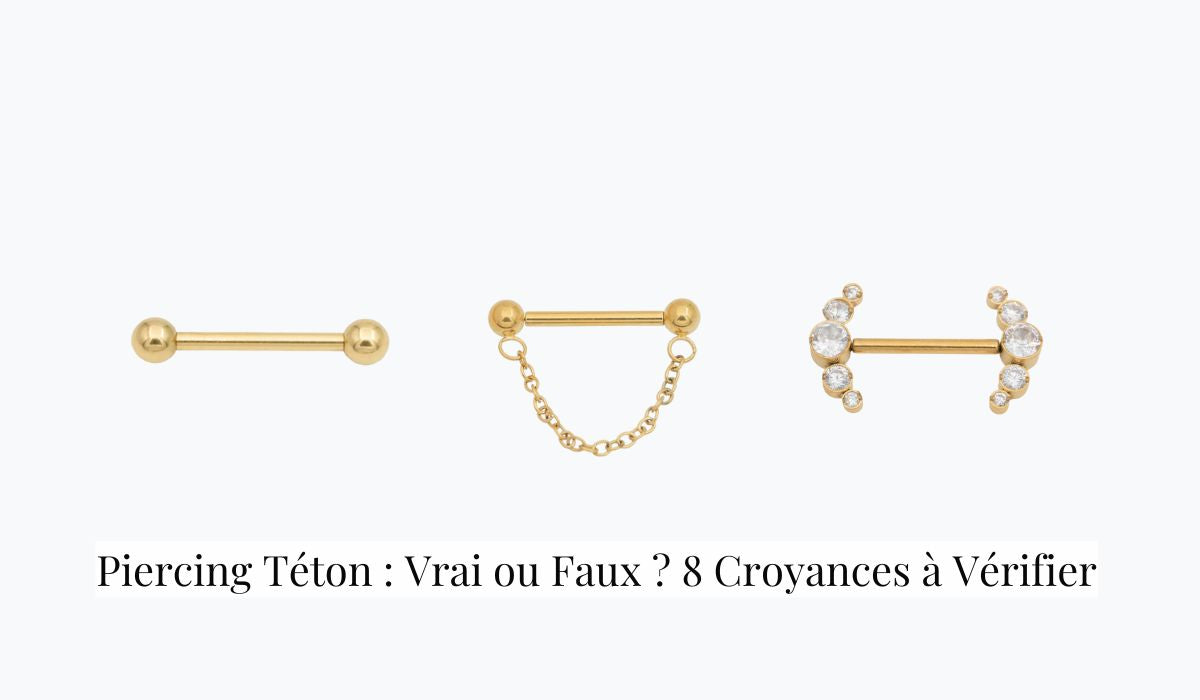
- Choose the right jewellery: straight barbells are more discreet than hoops, especially with small balls. At Obsidian Piercing, we recommend choosing a basic barbell.
- Choose the right clothing: thick or padded underwear fabric helps hide the outline of the jewellery. For men, a fitted t-shirt under a shirt or jumper can help minimise the piercing's visibility. We recommend only using thicker fabrics once your nipple piercing has fully healed.
7. You Can Change Your Piercing Jewellery After 1 Month – True or False?
Answer: False
Changing your jewellery after just one month is strongly discouraged, as a nipple piercing generally takes 6 to 9 months or more to heal for women, and around 3 to 4 months or more for men. Changing it too early can cause irritation and infection, and even delay healing.
What's more, removing the jewellery too soon can cause the channel to close up quickly, making it hard to insert new jewellery.
8. Cold and Water Slow Down Healing – True or False?
Answer: True
Exposure to cold can cause blood vessels to contract, which slows blood flow and can delay a piercing's healing.
What's more, cold can cause dry skin, making it more prone to irritation and increasing the risk of tiny cracks forming around the jewellery.
To avoid these issues, we recommend protecting your piercing in winter by wearing clothing that limits direct exposure to the cold.
In the shower, it's best to avoid water that's too hot, as this can dry out the skin even more. At the pool or the beach, it's essential to rinse the piercing well with clean water after every swim, to remove any chlorine or salt residue, which can irritate the pierced area.
The nipple piercing is often surrounded by myths and misconceptions. Now that you have the answers to the most common beliefs, you can make a fully informed decision. Always be sure to choose quality jewellery, like ASTM F-136 titanium, for optimal healing. Discover our collection of jewellery for nipple piercings.